
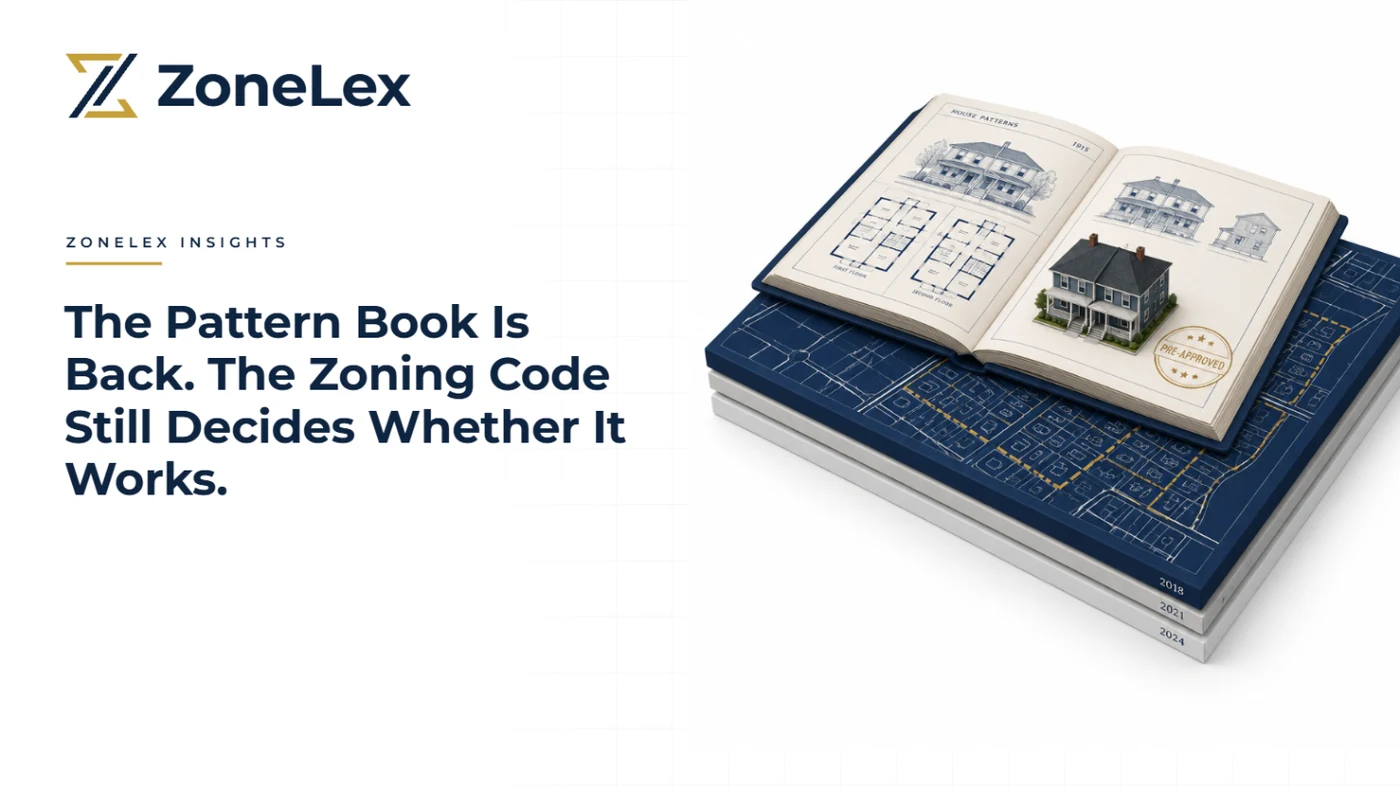
A century ago you could order a house from a catalog. Sears sold tens of thousands of them, and builders across the country used stock plans for duplexes, fourplexes and corner storefronts without a design review board in sight. That era ended when zoning codes and discretionary review made every lot a custom legal problem.
Now the catalog is coming back, with a government stamp on it. In May, The Pew Charitable Trusts published the first national look at preapproved building plan programs, counting 44 operating programs across roughly 40 jurisdictions. Four states have passed enabling laws, three of them in 2025. And in July, the ROAD to Housing Act folded the Accelerating Home Building Act into federal law, directing HUD to fund the adoption of pre-reviewed designs for ADUs, duplexes and townhouses so they can skip local design review.
For anyone who practices land use, this is worth a close read. Not because pattern books are new, but because of what they do and do not change about the code underneath them.
What the programs actually deliver
The numbers are modest on cost and meaningful on time. Pew estimates a preapproved plan saves roughly 1 to 2 percent of total development cost, about $5,000 to $10,000 on a $500,000 home, mostly by removing the architecture and engineering spend that NAHB puts at about $6,480 per single-family build. Local estimates run higher: up to $12,500 in Fayetteville, Arkansas, and $10,800 in Yavapai County, Arizona.
Time is where it bites. Claremore, Oklahoma reports an 80 percent cut in approval time, with ADU and duplex permits issued in 24 to 48 hours. South Bend, Indiana answers pattern book applications within two business days and has permitted 223 units through its nine designs in three years, including a six-unit apartment building. Seattle’s seven ADU plans account for roughly 9 percent of detached ADUs permitted through 2024. Jackson, Michigan’s two-plan program is now about a fifth of all new permitted housing in the city.
Set that against the baseline. Wharton survey data puts the average discretionary review at 4.3 months for single-family and 4.9 months for multifamily, and a Washington State study estimates each month of permitting delay adds about 1 percent to building cost. Pew’s conclusion is that heavily regulated cities take about 2.5 times longer to approve projects than lightly regulated ones. A pattern book attacks that gap directly.
What they do not deliver
Here is the part that matters for counsel. A preapproved plan is an approval of a building. It is not an approval of a lot.
Pew is explicit that pattern books are not a substitute for zoning reform, and the case studies show why. Cupertino, California adopted plans and built three units, because every other department still had to sign off. Portland built one ADU. Rigid designs that could not flex to odd lot widths went unused. And every plan carries an expiration risk: when the building code cycle turns, the preapproved set has to be re-reviewed or it quietly stops being valid.
Three features of these programs deserve attention from anyone advising a client:
- Pattern zones are overlays. Several cities, including Bryan, Texas with its 12-unit Midtown buildings, limit preapproved plans to a mapped district. That is a zoning overlay by another name, with boundaries, conditions and an adoption date that have to be confirmed parcel by parcel.
- The plan is only as current as the code it was reviewed against. Pew recommends cities budget for plan maintenance after each code update. In practice that means a plan approved under the 2021 code can sit on a city website for a year after the 2024 code takes effect. Which version governs on the day your client applies is a question the catalog will not answer.
- Lot-specific conditions still control. Setbacks, impervious coverage, tree protection, stormwater, sewer capacity, historic districts and HOA covenants all survive the stamp. South Bend pairs its plans with sewer connection reimbursements and Port Angeles with $5,000 to $20,000 in fee waivers precisely because the plan alone does not clear the site.
Why it matters for land use practice
The pattern book shifts work rather than removing it. A client who could once be told “this will take four months and we will know more after design review” will now ask a sharper question: can we use the city’s plan on this parcel, and how fast? Answering it means confirming the overlay boundary, the effective date of the plan set, the code cycle it was reviewed under, and every site condition that discretionary review used to surface along the way.
The ROAD Act will accelerate this. HUD grant money will push dozens more jurisdictions to adopt pattern books in the next two to three years, often small cities with thin planning staff and no process for keeping plan sets current. The jurisdictions most eager to adopt are the ones least equipped to maintain. That is a records problem before it is a design problem, and it will land on the desk of whoever is responsible for telling a client what the law allows today.
The catalog is a good idea. It was a good idea in 1915. The difference now is that the code it sits on changes every year, in every jurisdiction, on its own schedule. The plan is the easy part.
ZoneLex is building the jurisdiction-aware record that questions like this depend on: which authorities govern a parcel, which version of the code applied on a given date, and what changed in between.
The plan is the easy part. The code underneath is the job.
Sources:
21st Century ROAD to Housing Bill Becomes Law, Holland & Knight (August 2026) →