
The news
California SB 79 is one of the many state preemption laws passed in recent years, and it took effect July 1, 2026. It requires local governments in qualifying urban counties to allow eligible multifamily housing on residential, mixed-use, or commercial sites near designated rail and bus rapid transit stops, overriding certain more restrictive local zoning rules.
Several lawsuits have followed. I won’t get into the litigation here. What interests me is what SB 79 shows about why ZoneLex needs to exist.
Trent’s take
In plain terms, the state is telling cities to increase urban density and create affordable housing, focused on areas where mass transit is easy to reach. That is a common theme across state preemption laws: create compact, affordable housing, ease traffic, reduce the parking requirements written into local zoning, and encourage growth along transit corridors.
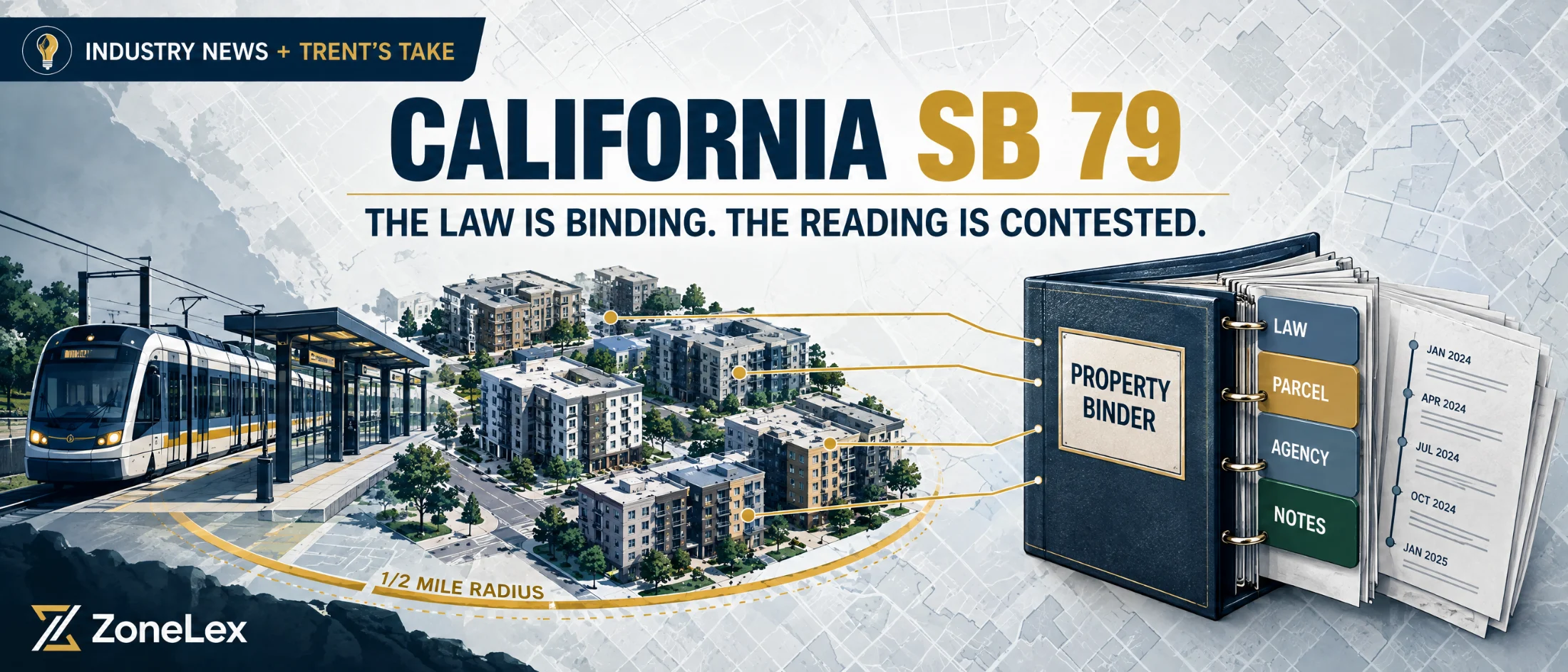
The issue: While SB 79 is binding state law, disputes over how local governments interpret its detailed requirements can leave a property’s eligibility for expanded housing development contested.
The problem it creates: Uncertainty around how state preemptions are interpreted can disrupt project plans, timelines, and budgets.
The opportunity for ZoneLex: It becomes critical for land-use professionals to track the applicable laws, government decisions, and supporting evidence from day one.
That is the thesis behind ZoneLex. Land-use decisions depend on more than the zoning code. They depend on how laws, parcel-specific facts, government interpretations, and project history fit together. Our Property Binder approach is designed to preserve that context from initial feasibility through the project lifecycle, helping professionals identify conflicts, evaluate changes, and maintain a source-backed basis for their decisions.
A land-use attorney needs a system that can remember and recall the answers to four questions:
What did we conclude, what supported it, what did the government do, and what has changed since?
The value starts before the application
A project starts when someone asks, “Could this site work?” From that point forward, the team is gathering information, making assumptions, talking with agencies, and recommending decisions.
The Property Binder preserves the basis for those decisions: the applicable law, the parcel facts, the government’s position, and the professional’s reasoning captured in their annotations. As the project develops, that record develops with it. We are not just helping someone find an answer today. We are helping the team understand and revisit that answer months or even years later without reconstructing everything from scratch.
The legal professional is central
Knowing what a code says is different from determining what a client can reasonably rely on. When the statute, the local interpretation, and the parcel facts point in different directions, someone has to evaluate the conflict, explain the uncertainty, and advise the client.
That is the work we are built to support, not replace.
This is where a jurisdictionally aware approach matters. We preserve which authority said what, rather than blending conflicting sources into one confident-sounding answer. Surfacing a conflict for professional review is more valuable than producing an answer that hides it.
The project history is part of the value
When something changes, the useful question isn’t just “What’s new?” It’s “Does this affect our project, and which earlier decisions need another look?”
That makes preserving dated sources, assumptions, actual submissions, and agency responses critical. Not overwriting yesterday’s record with today’s information becomes invaluable. The workspace should also keep a clear line between what was prepared internally and what was actually submitted, and we want to work through the best way to do that with our clients as we build.
To be clear, the Property Binder does not create legal rights or replace counsel’s analysis of issues such as vesting, and it was never meant to. Its role is to preserve the information professionals need to evaluate and support their positions for the lifetime of the project.
That is the difference between a living project record and a one-time zoning report or point-in-time zoning memo.
Sources:
SB 79 Transit-Oriented Development, California Department of Housing and Community Development →
Cities Scramble to Comply With or Fight Major State Housing Law, CalMatters →