Every year, land-use professionals lose countless hours untangling a hyper-localized mosaic of zoning codes across 33,000+ municipalities, just to answer one question for their clients: what can legally be built here? We’re building the data infrastructure and the tools to change that.
ZoneLex’s AI-enabled Small Language Model workspace provides accurate, parcel-specific answers while greatly reducing hallucination risks. Our DaaS platform delivers zoning law, along with the policy signals that shape it, with an auditable, evidentiary chain of custody, systematically decoding hyperlocal regulations and city council conversations to unlock value across a U.S. construction market of over $2 trillion.
Zoning law changes overnight. It means something different in every city. The record often lags behind the actual law. And right now, most of it lives in PDFs, email threads, and loosely managed folder structures, not in any single place an attorney can trust.
Of the $1.5–2.1 trillion in development capital that moves through the U.S. every year, close to a quarter never becomes a building. It is absorbed by regulatory cost, entitlement delay, and rework, or it is quietly shelved once the timeline stops penciling out. On the residential side the pattern is measurable: regulation accounts for 26.4% of the price of the average new single-family home built for sale, roughly $131,700 a house, according to NAHB’s June 2026 special study. That is not land, labor, or materials. Behind every one of those percentages is a real project: a housing development that doesn’t get built, a business that doesn’t get its permit, a community that waits longer than it should.
33,000+Municipalities with zoning codes, each with its own vocabulary
26.4%Of the price of the average new single-family home is regulatory cost, not land, labor, or materials
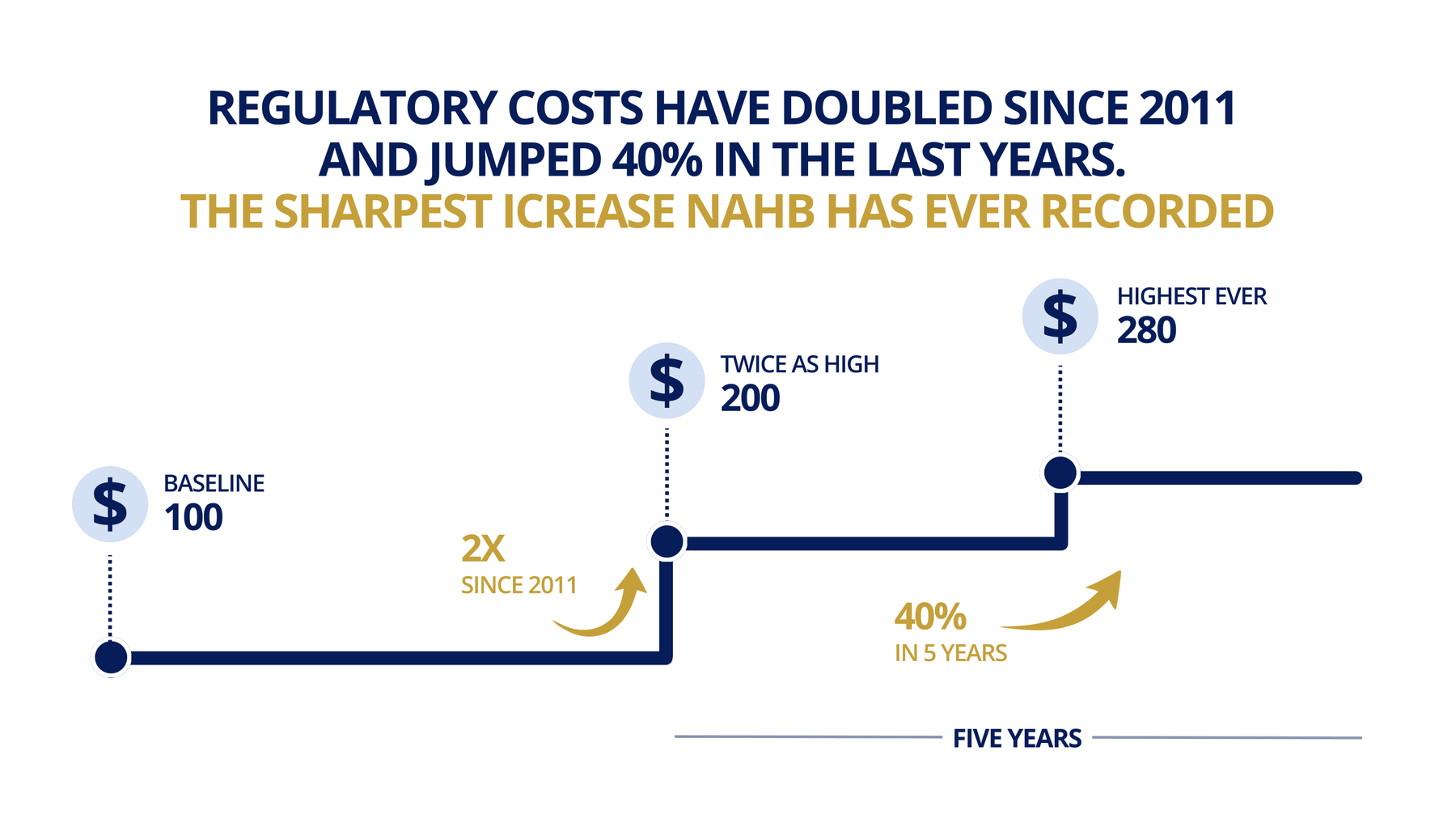
Regulatory costs have doubled since 2011 and jumped 40% in five years, the sharpest increase NAHB has ever recorded.
Market Data
The Month’s Construction Spend Report
Every month the U.S. Census Bureau publishes what the country actually spent on construction. It is the clearest available read on the market ZoneLex is built to serve, and the number sitting behind every entitlement decision our users are asked to de-risk.
ZoneLex is partnering with land-use attorneys to build a single, evidence-linked workspace; every fact tied back to a real, verifiable public record. Not a black box. Not a guess. A synthesizer of retrieved evidence, built specifically for the way land-use law actually works, solving the actual problems we are hearing from the field.
Evidentiary, not generative
Every fact traces to a public record.
Human-in-the-loop, always
The attorney makes the final call, not the AI.
Built for how fast this moves
Codes, agendas, and amendments move constantly. We monitor the conversation, not just the published code.
Want to be a part of building something revolutionary?
Zoning shifts in council chambers and hearing rooms long before the published code catches up. That lag between the conversation and the record is exactly what we monitor.
Key Users
Who we’re building this for.
Land-Use & Land-Development Professionals
One current record for the whole entitlement path.
Planners, entitlement managers, land-development consultants, and civil teams working the same parcel from the same sourced, current record instead of six stale copies.
What is ZoneLex, and how does this “legal trust layer” for zoning AI work?
ZoneLex is a specialized, collaborative AI-enabled workspace, currently in development, designed to give land-use professionals a single, evidence-linked source of truth for zoning research, anchored to a specific parcel of land and maintained across the life of the project.
What problem is ZoneLex, a zoning due diligence tool, trying to solve?
Land-use professionals currently research zoning across 33,000+ municipalities with no shared vocabulary, relying on scattered PDFs, email threads, and folder structures. ZoneLex is being built to replace that with one auditable, source-linked workspace: the kind of entitlement risk software the market currently lacks.
Does ZoneLex reduce legal AI hallucination risk and give land-use teams a defensible record?
Yes, that’s the core design principle. Every fact is meant to trace back to a verifiable public record rather than being generated freehand, which is the same evidentiary standard driving legal AI ROI conversations across the industry. ZoneLex does not replace land-use professionals; it’s built to assist their workflow. Land use is deal work as much as legal work, and the goal is rarely to be absolutely right on the record. It is to know the law well enough to guide a client toward the best possible outcome. ZoneLex puts the complete, sourced record in front of the attorney, and the judgment stays theirs.
Who is ZoneLex being built for?
Primarily land-use and land-development professionals, paralegals, and associates at law firms, including firms evaluating AI tools for land use practice, but also with a focus on developers and investors who want to check zoning before buying land, through the counsel or land-use advisors they trust. See Who We’re Building For for details.
How can attorneys track municipal code changes and automate zoning research?
ZoneLex’s ingestion engine is being built to monitor source data continuously and flag new ordinances or amendments, along with the policy signals that shape them, as they happen, replacing manual zoning research automation gaps with a standing, auditable record.
What is ZoneLex’s connection to the broader proptech and legal AI landscape in 2026?
ZoneLex sits at the intersection of proptech and legal AI, built specifically as a legal trust layer for zoning, rather than a general-purpose legal AI or property-data tool. Among the landscape of proptech legal AI companies, we are focused on project-based zoning research and monitoring for land-use professionals: a workspace that stays with a project from the first feasibility question through entitlement, rather than a one-lookup-and-done search tool.
Meet the Team
Built by a team that’s spent careers making complicated systems reliable at scale.